

The plague of bad breath; sometimes it’s hard not to put your foot in your mouth, especially if someone else’s mouth smells like feet. As a general dentist, I have immunity when it comes to discussing halitosis with my patients — or my wife, who eats enough garlic to fend off Dracula.

But you don’t have that luxury. So let’s get to it.
How Do I Tell Them?
Mouthwash won’t make it go away (for long). So as tempting as it may be, skip leaving a travel-sized bottle on a coworker’s desk and hoping they get the hint.
First, a rule: do this in private. Not around the Keurig. Not in a group text. Not by copying this article to your Facebook page and tagging them. (Please don’t do that.)
If you know the person is sensitive, you may need to be even more cautious in your approach. Delicately bring up the issue by carrying mints with you. Take one yourself first and then offer one to your friend who has bad breath. If the person doesn’t accept, give them a nudge and simply say, “I think you should.”
If mints aren’t going to cut it, and sometimes they won’t, go with a direct but kind approach. Ask to speak privately and say: “Hey, I’m only saying this because I’d want you to tell me. Something’s a little off with your breath.”
Consider these pointers if you’re struggling with the need to let your boyfriend/girlfriend/office crush/parent/teenage boy that they have bad breath:
- Choose the right time and place. Privacy matters.
- Be gentle. This isn’t a confrontation, it’s a favor.
- Use “I” statements. “I noticed something I thought you’d want to know.” Short, kind, done.
- Suggest practical solutions. Sugar-free gum, mouthwash, a visit to the dentist. Give them somewhere to go with the information.
- Respect their response. You said your piece. Your job is done.
Failing that, you could do what I did, which was to down about 10 of those synthetic garlic capsules and then go find my wife.
Psst. If you’re reading this, there’s a good chance you already know who you want to send it to. Go ahead. Share it on Facebook.
But Here’s the Part That Might Surprise You
The person you’re about to tell? They genuinely have no idea. It’s not because they don’t care about their hygiene or because they’re oblivious. It’s biology, and honestly, it’s kind of fascinating.
Why Don’t They Smell It?
There are many reasons why someone (else’s) mouth can smell like a sewer, including food, tobacco, poor dental hygiene, and health problems such as sinus infections, acid reflux, and lactose intolerance. The problem with bad breath is that it’s more of a problem for everyone else than it is for the offender. Unlike mouth breathing, it is talking that brings out odors from the back of the mouth, where bad breath originates.
Notice if you huff a puff of breath into your hand, it generally won’t give an indication of how your mouth smells, because your throat is used differently when you talk versus breathe. People tend to become desensitized to their own smells, so it’s hard for someone to notice if they habitually reek like cheese that’s been left in the fridge past its sell-by date.
There’s actually a reason for this beyond habit. Thousands of years ago, a hunter preoccupied with the smell of his own breath would have been terrible at tracking prey. So the brain adapted. It learned to filter out constant, familiar smells so you could stay alert to new information in your environment. In the modern world, that ancient advantage has become a distinct social liability.
The actual culprits are bacteria that thrive in low-oxygen environments like the back of your tongue and deep gum pockets. As they break down proteins, they produce Volatile Sulfur Compounds, or VSCs. That’s the chemistry behind the smell. Sulfur. The same family of molecules responsible for the charming aroma of rotten eggs.
So if the hand puff doesn’t tell you anything, what does? Three tests that actually work:
- The Talk Test: Cup your hands over your mouth, say something out loud, then smell your hands. Talking releases odors from the back of the mouth in a way that a simple breath puff doesn’t. “Peter Drews is my favorite dentist” works fine as a test phrase.
- The Lick Test: Lick your wrist, let it dry for a moment, then smell it.
- The Floss Test: Run floss between your back teeth and smell it immediately after.
Your back teeth are where the bacteria concentrate. If the floss test gets your attention, that’s useful information.
What’s Actually Causing It?
Bad breath has a lot of possible sources. Most are fixable; a few are worth paying closer attention to.
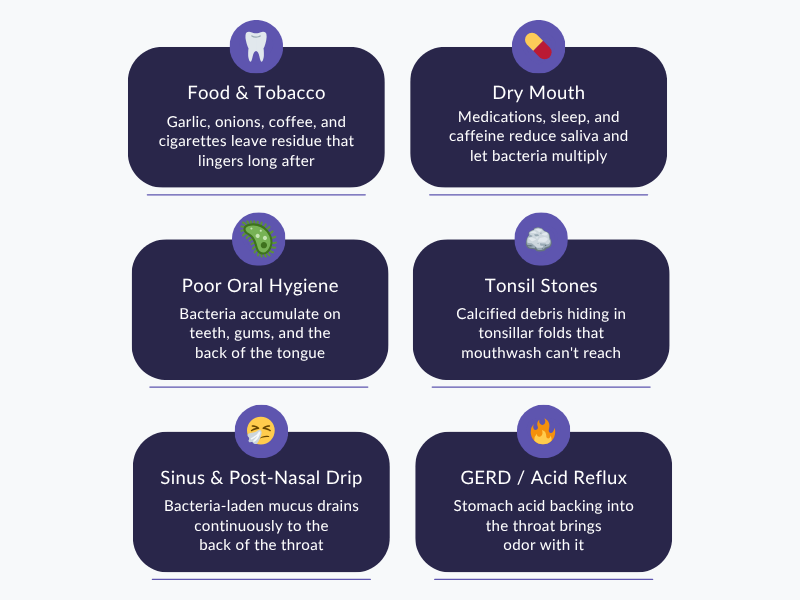
Food and tobacco are the obvious ones. Garlic and onions are the classic offenders. The compounds that cause the odor don’t just linger in your mouth. They get absorbed into your bloodstream and expelled through your lungs, which is why brushing right after a garlicky meal only helps so much. If garlic is your particular weakness, check out how to get rid of garlic breath.
Coffee and cigarettes work differently. Residue builds up in the mouth and throat and sticks around well past the last sip or the last smoke. If it has a strong smell going in, it has a strong smell coming out.
Poor oral hygiene is the classic cause. Bacteria accumulate on teeth, gums, and especially the tongue. The back third of the tongue is the single biggest bacterial reservoir in the mouth, and most people never clean it. A tongue scraper does more for morning breath than any mouthwash on the market. Studies show tongue scraping reduces odor-causing sulfur compounds by up to 42%.
Dry mouth is an underrated one. Saliva is your mouth’s natural cleaning system. It rinses, buffers acid, and keeps bacterial populations in check. When saliva flow drops, bacteria multiply fast. Dry mouth happens during sleep, which explains morning breath, but it also shows up as a side effect of dozens of common medications: antidepressants, antihistamines, diuretics. If you’re on a regular prescription and notice persistent bad breath, mention it to your dentist.
Tonsil stones are the ones nobody talks about. The folds of your tonsils can trap food debris, bacteria, and minerals that calcify into small, foul-smelling lumps. They sit too far back for mouthwash to reach. If you feel like something is stuck in your throat or notice a persistent bad taste with no obvious cause, tonsil stones are worth investigating.
Sinus infections and post-nasal drip send bacteria-laden mucus to the back of the throat continuously. The smell isn’t coming from the teeth at all.
GERD, or acid reflux, allows stomach acid and partially digested food to back up into the esophagus and throat. Patients often describe a sour or bitter taste. If that sounds familiar, the source of the odor is gastrointestinal, not oral, and brushing harder won’t help.
Ready to Put It Into Practice?
You’ve got the how-to advice, the science behind why they can’t smell it, and a rundown of what’s actually causing it. The hard part is doing it in the moment. Reading the room, finding the right words, knowing when a mint is enough and when a real conversation is needed. That looks different depending on who you’re dealing with.
How Would You Handle It?
Six scenarios. Someone near you has bad breath. What do you do?
Find out if you’re a tactful genius or a social liability.
Bad breath is one of those things everyone notices and nobody mentions. You’re already ahead of the curve just for reading this far.
I also wrote How to Prevent Bad Breath, which is worth a read if you suspect you might be on the receiving end of this conversation,